



Grinding ball transportation requires careful planning because forged steel grinding balls are dense industrial cargo. When they move from a manufacturing plant to a port, warehouse or mine site, the packaging and load-securing plan matter as much as the route itself. This guide explains the practical checks buyers and logistics teams should consider when transporting grinding media in jumbo bags.
Quick answer: To transport grinding balls by truck, confirm the vehicle’s permitted payload and axle loads, select bulk bags with an appropriate safe working load, distribute the cargo correctly, use a load-specific restraint system with suitably rated equipment and anchor points, and inspect the arrangement before departure. Visible lashing straps alone do not prove that a load is safely secured.
Why do forged grinding balls require careful transport planning?
Grinding media for ball mills and SAG mills have a high mass relative to their volume. They may be packed in flexible intermediate bulk containers (FIBCs), commonly called jumbo bags or big bags. Some shipments use bags filled with approximately 1,000 kg, but the permitted weight depends on each bag’s specification and intended handling method.
Sudden braking, cornering and road vibrations can produce movement and forces on the load. Poor restraint or inappropriate contact surfaces can damage bags, while an uneven loading arrangement may affect vehicle stability or axle-load compliance.
1. Check vehicle payload and distribute weight correctly
Before loading, the carrier should confirm the vehicle’s rated payload, axle limits, platform condition and cargo dimensions. The arrangement must keep the weight within applicable limits and allow the load to be restrained in all relevant directions.
Place jumbo bags on suitable supporting surfaces, assess gaps and potential contact with metal edges, and do not assume that tightly packed bags can replace a correctly designed securing system. Blocking or other measures may be needed depending on the vehicle and cargo.
2. Select suitable jumbo bags and inspect the packaging
For heavy steel grinding media, the packaging specification must match the packed mass and planned lifting method. Before dispatch, inspect the bag’s safe working load (SWL) marking, seams, lifting loops, closure and fabric condition. Check for sharp surfaces and abrasion risks.
Lifting loops designed for handling a bag should not automatically be used as cargo-securing anchor points. Such use requires verification of the bag design and the complete restraint method.
3. Assess lashing straps, anchors and restraint geometry
Lashing straps are one possible part of a load-securing system, but their quantity or visual appearance cannot establish whether the arrangement is adequate. The securing plan should account for cargo mass, friction, expected forces, restraint angles and the vehicle configuration.
- Rated equipment: Check the relevant lashing capacity (LC) and the condition of straps and fittings.
- Anchor points: Verify that the vehicle’s attachment points are suitable for the securing forces.
- Restraint method: Assess whether direct lashing, frictional restraint, blocking or a combination is appropriate.
- Bag protection: Avoid damaging the packaging with straps, edges or concentrated pressure.
A transport professional should verify the complete arrangement against applicable local rules and the actual vehicle and cargo. There is no universally correct number of straps for every truckload of grinding balls.
4. A real loading operation at Shandong Gangyan
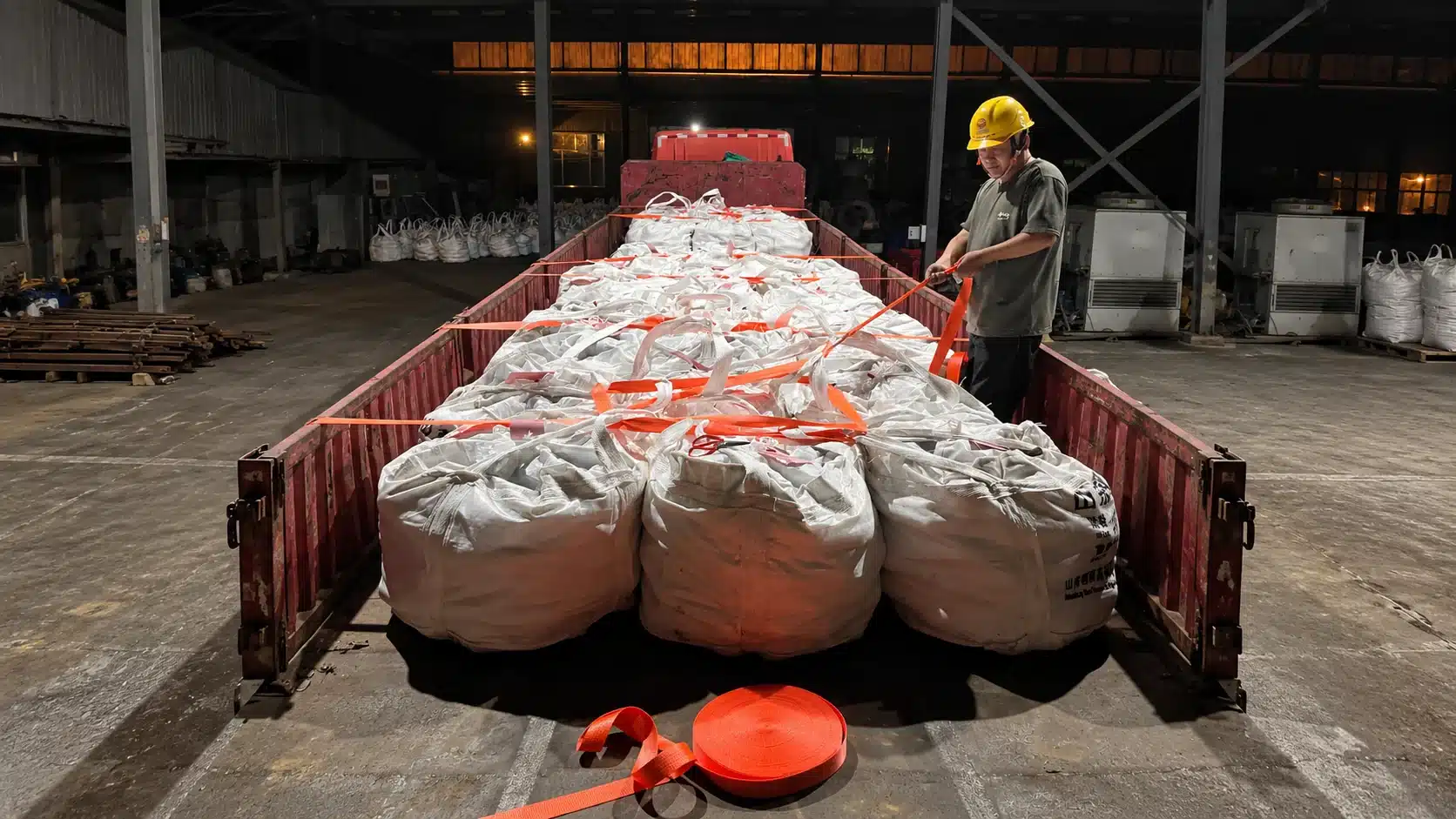
The accompanying factory photograph shows white jumbo bags arranged on a truck at Shandong Gangyan in Shandong Province, China. Orange lashing straps are visible, and a worker is adjusting equipment during the loading process.
This authentic image illustrates one stage of preparing bulk-packed grinding media for road transport. It does not by itself confirm strap ratings, anchor strength, total load weight or the results of a safety inspection. Those details must be checked separately before a shipment is released.
5. Final checks before the truck departs
- Confirm the shipment weight, vehicle payload and axle-load limits.
- Inspect jumbo bags, seams, loops and any points of potential abrasion.
- Check the selected securing system, attachment points and protective equipment.
- Verify shipping and handling instructions, and arrange any appropriate checks during the journey.
6. Consider the full export delivery chain
International grinding ball orders often involve factory-to-port trucking, container packing, ocean freight, destination-port handling and onward road delivery. The requirements of each stage can differ; a solution appropriate for a truck bed should not simply be copied into a shipping container.
Mining buyers should confirm container payload and verified gross mass requirements where applicable, along with local road restrictions and discharge arrangements. Under CIF Incoterms® 2020, the seller arranges and pays for the sea carriage and the required insurance to the named destination port; inland delivery from that port to a mine is not automatically included.
Frequently asked questions
How are forged steel grinding balls packaged for export?
Depending on the agreement and handling requirements, grinding balls can be supplied in suitable jumbo bags or other industrial packaging. The safe working load and handling method must be confirmed for the selected package.
Can grinding balls be shipped in a 20-foot container?
Yes, 20-foot containers are often considered for dense grinding media. The permitted shipment weight depends on the specific container rating, carrier restrictions, verified gross mass and inland transport rules; it should not be assumed from a generic tonnage figure.
Are visible lashing straps enough to confirm cargo safety?
No. The rated restraint capacity, anchor points, cargo mass, friction, geometry and complete loading arrangement must be assessed. The photograph is an illustration of work in progress, not a certification of compliance.
What should a buyer provide for a grinding ball quotation?
Please share the required ball diameter, quantity in metric tons, mill application or ore type, and destination port. Material and packaging requirements can then be reviewed alongside the commercial delivery terms.
Conclusion
Reliable grinding media supply involves both product quality and sound delivery planning. Appropriate packaging, balanced loading, verified restraints and pre-departure checks help manage the risks of transporting heavy steel balls.
Shandong Gangyan Grinding Ball Co., Ltd. manufactures forged steel grinding balls for mining ball mills and SAG mills. To request a quotation, provide your required diameter, tonnage, application and destination port through our website.
Technical reference
The IMO/ILO/UNECE Code of Practice for Packing of Cargo Transport Units (CTU Code) provides non-mandatory international guidance on packing and securing cargo in transport units. Local road-transport regulations and a vehicle-specific load-securing assessment must also be considered.