



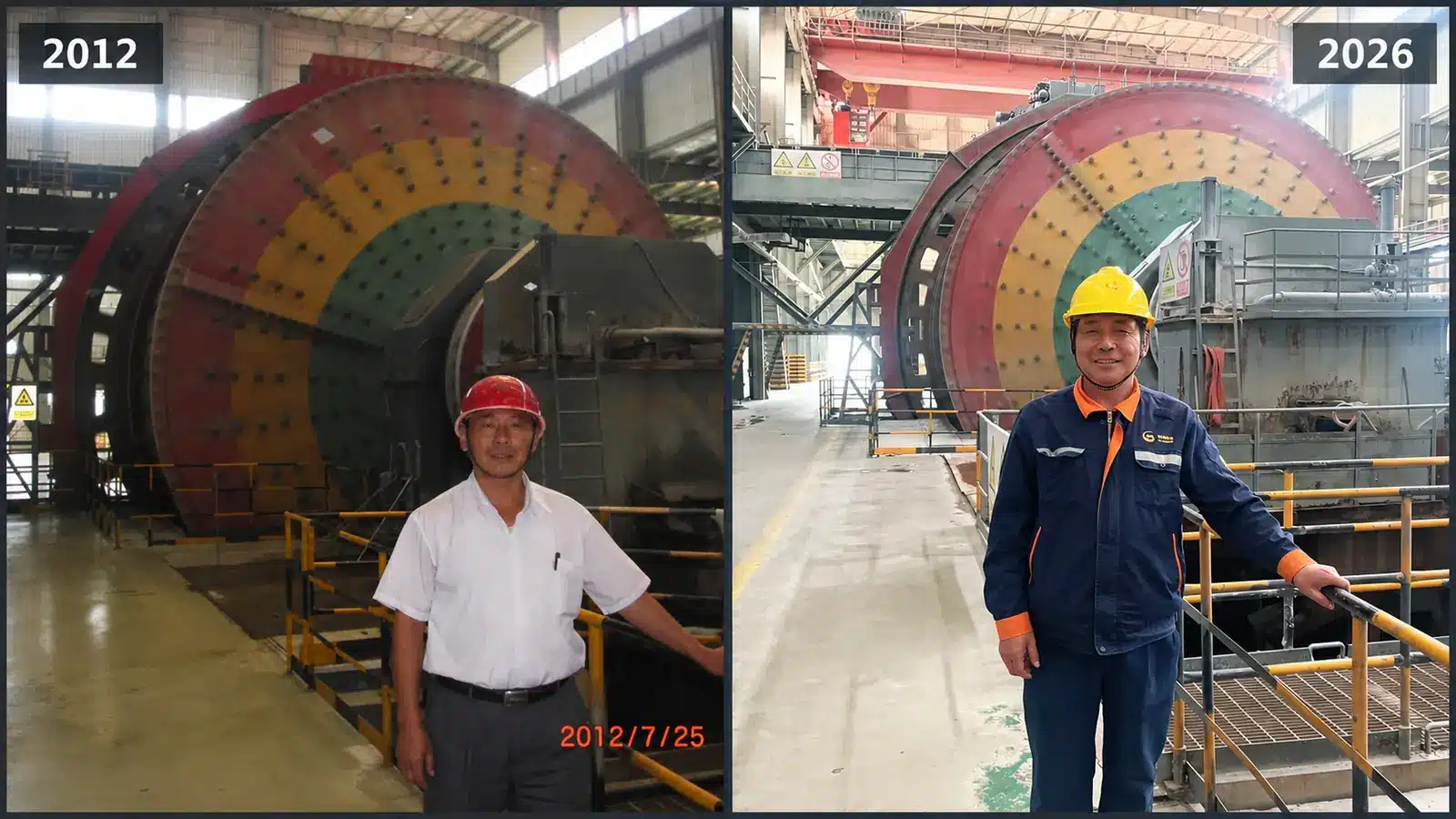
Two photographs. The same mill. Fourteen years apart.
The first photograph was taken on July 25, 2012. The second was taken on September 5, 2026. Both are real site photographs from the same milling operation, recording Shandong Gangyan’s involvement with the customer across a fourteen-year period.
What changed was time. The workwear and image quality also reflect two different periods. What did not change was our commitment to product quality, responsibility for the grinding balls we supply and service that continues after delivery.
The short answer: long-term grinding ball service does not mean supplying the same specification repeatedly without review. It means maintaining consistent product and batch control while continuing to examine the mill, ore, operating conditions and field performance. The 2012 and 2026 photographs document continuity at the same mill; the technical value behind that continuity comes from measurable quality records and operating data.
What the 2012 and 2026 Photographs Show
The 2012 photograph records an earlier stage of our work at this large milling operation. The 2026 photograph shows Gangyan at the same mill again, fourteen years later.
For a grinding ball supplier, returning to the same operation after many years carries practical meaning. It suggests that the relationship has extended beyond a single quotation, one shipment or a short sales cycle. It also creates a longer history from which the supplier and the customer can understand product application, changes in operating conditions and the importance of consistent follow-up.
However, photographs should be interpreted accurately. They are evidence of real site presence and long-term service involvement. They are not, by themselves, proof of a specific wear rate, breakage rate or production-batch result. Those conclusions require corresponding operating records, batch inspection reports and comparable test conditions.
This distinction matters. Reliable industrial marketing should show genuine experience without turning one image into a technical claim that the image cannot prove.
What Changed During Fourteen Years?
Time changes every mining and mineral-processing operation. Even when the main mill remains in service, the conditions surrounding it may not stay identical.
Over a fourteen-year period, an operation may experience changes in:
- ore source and mineral composition;
- ore hardness and quartz content;
- feed size and feed preparation;
- plant throughput targets;
- mill speed, filling level or ball charge;
- liner design and liner condition;
- grinding-ball diameter or replenishment practice;
- target product size or downstream process requirements; and
- maintenance and production schedules.
Any of these factors can influence grinding-media consumption and wear behaviour. For this reason, a supplier should not assume that the specification used successfully in an earlier period will automatically remain the best option under new conditions.
Long-term experience is valuable because it provides historical context. It does not remove the need for current operating data.
What Has Not Changed: Product Responsibility and Service
When we say that our commitment has not changed, we do not mean that every production parameter or product recommendation must remain fixed forever. Technical decisions should develop when the application changes.
What should remain consistent is the supplier’s responsibility to:
- supply the material and grade agreed with the customer;
- control chemical composition and heat treatment by production batch;
- verify the relevant surface and internal properties;
- maintain dimensional and surface-condition control;
- provide traceable inspection evidence when required;
- communicate honestly when operating data are incomplete;
- review field feedback after delivery; and
- recommend adjustments only when the evidence supports them.
For Shandong Gangyan, long-term cooperation is not defined only by the number of years on a calendar. It is defined by whether product quality, technical communication and after-sales follow-up remain dependable from one order to the next.
Long-Term Grinding Ball Supply Is a Continuous Process
A professional grinding ball supplier should remain involved before production, during manufacturing and after the balls enter service.
| Stage | Supplier responsibility | Evidence or information to review |
|---|---|---|
| Before recommendation | Understand the actual milling application | Mill type and diameter, ore characteristics, feed size, current ball size and grade, consumption in kg/t |
| Before production | Confirm the agreed product specification | Alloy grade, diameter, hardness requirements, impact requirements, packaging and inspection scope |
| During production | Control material, forming and heat treatment | Chemical-composition records, process records, hardness results, dimensions and surface inspection |
| Before shipment | Verify the production batch against the order | Batch-linked inspection report, quantity, packing marks and any agreed third-party inspection |
| After delivery | Review real operating performance | Tonnes of ore processed, balls charged, consumption in kg/t, wear pattern, breakage, spalling and deformation |
| During later orders | Compare results under equivalent conditions | Operating changes, batch identity, liner condition, ore changes and replenishment practice |
This process helps separate product-related issues from changes caused by the mill, ore or operating method. It also gives both parties a more reliable basis for deciding whether the existing grinding ball grade and diameter should be retained or adjusted.
Why Repeat Orders Still Require Technical Review
A repeat order may look simple, but the phrase “same as last time” is not always a complete technical specification.
Before confirming a repeat supply, useful questions include:
- Is the mine processing the same ore source?
- Has the feed size or throughput changed?
- Has the mill charge or replenishment method been adjusted?
- Are the current grinding balls wearing uniformly?
- Has the customer observed breakage, spalling or deformation?
- Is the reported consumption based on a comparable operating period?
- Can the field results be linked to the correct production batch?
If the operating conditions remain comparable and the performance is stable, repeating the established grade and diameter may be appropriate. If important conditions have changed, the recommendation should be reviewed before production.
This is not a complication added to the purchasing process. It is part of reducing technical and commercial risk.
How Grinding-Media Performance Should Be Evaluated
Grinding-media performance should not be judged from one isolated observation. A useful review combines operating data with physical inspection and batch records.
Grinding-media consumption
Consumption is commonly expressed in kilograms of grinding media per tonne of ore processed. The calculation should use a clearly defined and comparable period. A value is difficult to interpret if the tonnes processed, charging records or beginning and ending inventory are incomplete.
Wear behaviour
Recovered grinding balls should be examined for uniform size reduction, irregular wear, flat areas, excessive deformation or unusual surface damage. The wear pattern can provide information that a consumption figure alone cannot show.
Breakage and spalling
Broken balls and surface spalling should be recorded separately from normal abrasive wear. Photographs, sample retention and the relevant production-batch number can help determine whether further laboratory review is necessary.
Operating context
A change in grinding-media consumption does not automatically prove that grinding-ball quality has changed. Harder or more abrasive ore, higher quartz content, coarser feed, liner changes, an altered ball charge or a higher throughput target can all affect consumption.
Conversely, a stable monthly figure should not replace batch inspection. Field data and manufacturing evidence answer different questions and should be used together.
Quality Control Behind Consistent Forged Grinding Balls
Long-term service is meaningful only when it is supported by repeatable manufacturing and inspection.
Depending on the confirmed grade, diameter, contract and application, a forged grinding ball quality review may include:
- Chemical-composition analysis: confirms whether the steel chemistry corresponds to the agreed grade and production lot.
- Surface-hardness testing: checks the hardness at specified external positions.
- Core-hardness testing: requires a properly sectioned ball and measures hardness near the centre.
- Hardness-distribution testing: uses multiple points from the surface toward the core to evaluate the heat-treatment profile.
- Diameter and roundness inspection: checks dimensional consistency and forming control.
- Impact or drop testing: evaluates resistance to repeated shock, cracking and spalling under the specified test method.
- Metallographic examination: reviews the microstructure and heat-treatment result.
- Surface-condition inspection: identifies cracks, folds or other visible defects before packing.
- Batch traceability: connects inspection results to the products actually supplied.
No single number proves the complete quality of a grinding ball. A high surface HRC reading, for example, does not independently confirm core hardness, impact toughness, dimensions or batch consistency.
Matching the Grinding Ball to the Mill and Ore
Shandong Gangyan manufactures forged grinding balls in GY-45, manganese-alloy, B2 and B3 series for mining, cement and mineral-processing applications. Product selection should be based on the real duty rather than the alloy name alone.
Important selection factors include:
- SAG mill or ball mill configuration;
- mill diameter and operating speed;
- grinding-ball diameter;
- ore hardness, abrasiveness and quartz content;
- feed size and impact severity;
- required balance between hardness and toughness;
- current media consumption and wear pattern; and
- the customer’s operating and cost objectives.
B2 forged grinding balls are frequently considered for general mining and ball-mill applications requiring a practical balance of hardness, toughness and wear resistance. B3 or manganese-alloy products may be evaluated for suitable larger-diameter or higher-impact applications. The final recommendation must follow the confirmed specification and application data.
Long-term customer knowledge helps make this review more informed. It should never be used as a substitute for checking the current conditions.
What Buyers Should Expect from a Long-Term Grinding Ball Supplier
Mining buyers and distributors evaluating a supplier should look beyond a statement such as “many years of experience.” They should ask what that experience produces in practice.
A capable long-term supplier should be able to explain:
- how the proposed alloy grade and diameter were selected;
- which surface and core hardness requirements apply;
- how the heat-treatment process is controlled for the selected diameter;
- which inspection items are performed by production batch;
- how field feedback is linked to the supplied batch;
- how consumption is compared under similar operating conditions; and
- what corrective review is available if abnormal wear or breakage is reported.
The value of a long-term supplier lies not only in continuing to deliver. It lies in maintaining the technical discipline needed to make each delivery reliable.
About Shandong Gangyan Grinding Ball Co., Ltd.
Shandong Gangyan Grinding Ball Co., Ltd. is a China-based manufacturer and supplier of forged grinding balls for mining, cement and mineral-processing operations. The company supplies GY-45, manganese-alloy, B2 and B3 series for ball mills and SAG mills and supports product selection, production control, inspection and shipment documentation.
Gangyan’s application experience includes large SAG-mill environments with mill diameters of Ø8.8 m, Ø10.37 m and Ø11 m. Its quality-control scope includes chemical-composition analysis, surface and core hardness testing, hardness-distribution testing, dimensional and roundness inspection, impact testing, metallographic examination and surface-condition inspection.
The two photographs from 2012 and 2026 are part of that service history. What they record is not a slogan, but a long-term connection to a real milling operation.
Frequently Asked Questions
What does long-term grinding ball service include?
It includes application review, confirmation of the grade and diameter, production and batch inspection, shipment documentation, follow-up after delivery and comparison of field performance under equivalent operating conditions.
Should a supplier use the same grinding ball specification for every repeat order?
Not automatically. If the ore, feed size, throughput, liners, ball charge or operating targets have changed, the supplier should review whether the previous grade and diameter remain suitable.
How should grinding ball consumption be compared?
Compare kilograms of grinding media charged against tonnes of ore processed over clearly defined periods. The comparison should also consider changes in ore characteristics, feed conditions, mill operation, liners and ball-replenishment practice.
Does higher media consumption always mean the grinding ball quality changed?
No. Product quality may be one factor, but ore hardness, quartz content, feed size, throughput, liner condition, mill settings and charging practice can also affect consumption. Batch records and operating data should be reviewed together.
Which quality documents should a buyer request?
Request the agreed product specification and batch-linked results for chemical composition, hardness and dimensions. For demanding applications, also request the applicable impact or drop-test results, metallographic records and any agreed third-party inspection report.
Do the 2012 and 2026 photographs prove grinding ball performance?
The photographs document real site presence and a long-term service relationship at the same mill. Specific performance claims must still be supported by inspection reports, charging records, tonnes processed, consumption data and observations of wear, breakage or spalling.
What information does Gangyan need before recommending forged grinding balls?
Provide the mill type and diameter, ore information, feed size, current grinding-ball grade and diameter, media consumption in kg/t, any wear or breakage issues, the required quantity and the destination port.
Conclusion: Time Changed, Responsibility Did Not
The photographs taken in 2012 and 2026 show the same mill across fourteen years. They also express a principle that matters to us: time moves forward, but responsibility for product quality and customer service must remain.
Long-term cooperation does not mean repeating yesterday’s solution without question. It means preserving consistent manufacturing and batch control while continuing to review today’s ore, mill conditions and performance data.
For buyers, this approach provides something more valuable than a general promise. It provides a process for specifying, verifying and improving forged grinding ball performance over time.
To request a grinding-media recommendation from Shandong Gangyan, provide your mill type, mill diameter, ore characteristics, current ball grade and diameter, consumption in kg/t, observed wear behaviour and required quantity. Our team can then review a suitable forged grinding ball specification for your operating conditions.