



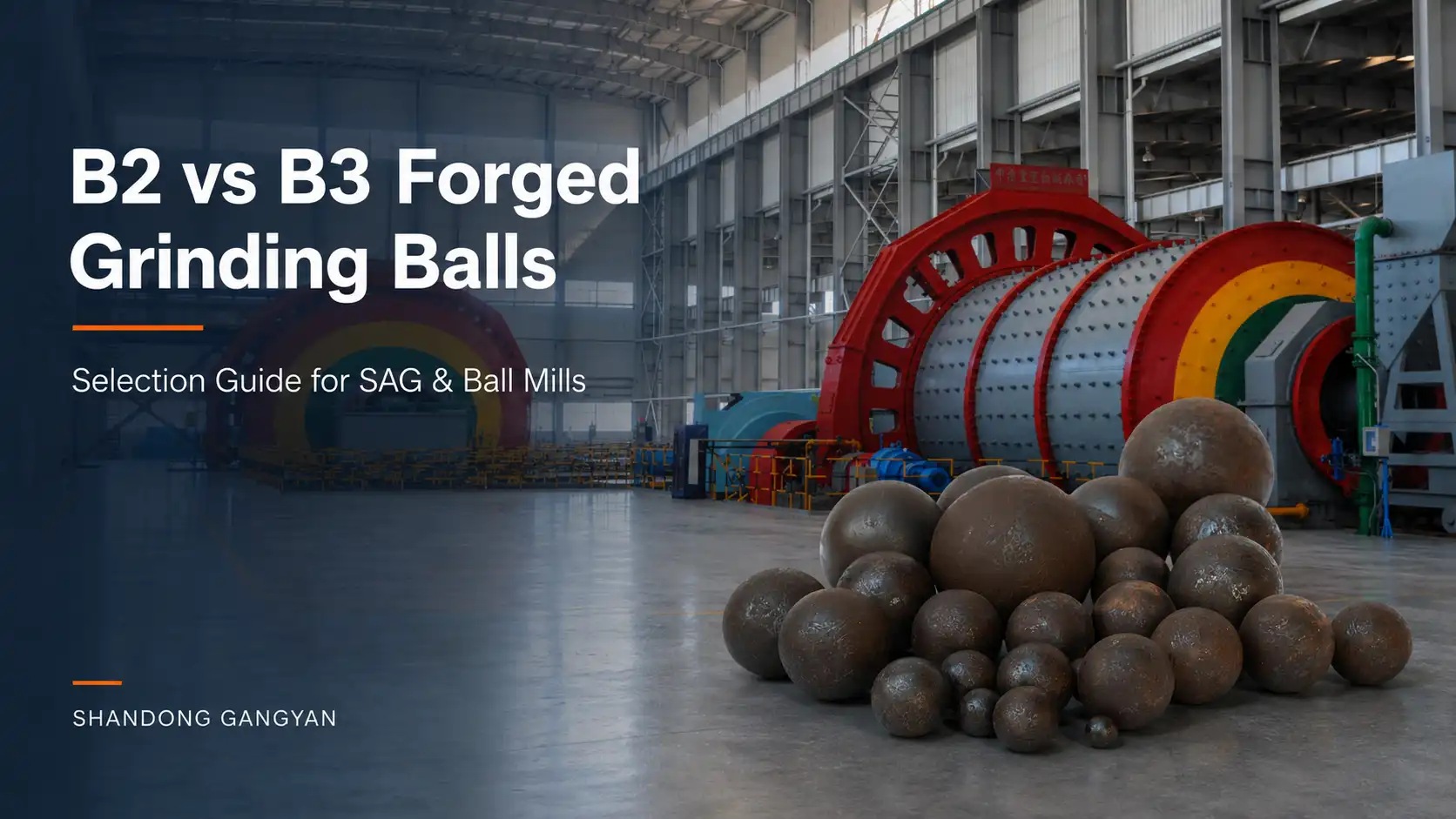
Choosing between B2 and B3 forged grinding balls should not begin with the grade name alone.
Two grinding balls may have similar surface-hardness values but perform differently under actual mill conditions. Mill configuration, ore characteristics, impact loading, current media performance and operating targets must all be reviewed before selecting a grade and diameter.
This guide explains the practical differences between B2 and B3 forged grinding balls and the operating information required for a technically responsible recommendation.
What Is the Difference Between B2 and B3 Grinding Balls?
B2 and B3 are alloy-steel grades commonly used for forged grinding media. Both can provide high hardness, wear resistance and impact strength when their chemical composition, forging and heat-treatment processes are properly controlled.
Their typical application profiles differ:
| Grade | Typical application | Main characteristics |
|---|---|---|
| B2 | Ball mills and general mining grinding | Controlled hardness and toughness; B2 can be through-hardened at suitable diameters |
| B3 | High-impact and abrasive grinding conditions | Grade and heat treatment matched to the agreed impact and hardness requirements |
These descriptions are application guidelines rather than universal rules. Grade names may also differ between manufacturers, so buyers should compare chemical composition, hardness distribution, impact resistance, metallographic structure and inspection records—not only the grade designation.
Four Factors to Review Before Selecting Grinding Media
1. Mill Configuration
The first step is to confirm how the grinding media will be used.
Important mill information includes:
- SAG mill or ball mill
- Mill diameter and effective grinding length
- Mill speed
- Filling rate
- Current ball charge
- Ball top-up practice
Large-diameter SAG mills usually expose grinding balls to repeated high-impact loading. Ball mills may place greater emphasis on wear resistance and stable consumption, depending on the ore and operating conditions.
A larger mill does not automatically require the hardest or largest available grinding ball. The selected media must provide an appropriate balance between hardness and impact toughness.
2. Ore Conditions
Ore properties directly influence grinding-media wear and impact behavior.
Before recommending a forged grinding ball, the following information should be reviewed:
- Mineral type
- Ore hardness
- Quartz or silica content
- Feed size
- Abrasiveness
- Variations in ore characteristics
Highly abrasive or quartz-rich ore may increase wear even when high-quality grinding media are used. For this reason, a supplier should not promise a specific consumption result without reviewing the actual ore and mill data.
3. Current Grinding-Media Performance
The performance of the grinding media currently in use provides valuable information for the next selection.
Useful operating records include:
- Current grade and supplier
- Ball diameter
- Surface and core hardness
- Wear rate
- Breakage rate
- Spalling or surface peeling
- Deformed or out-of-round balls
- Grinding-media consumption in kg/t
Breakage, accelerated wear and unstable consumption do not necessarily have the same cause. Each problem requires a different technical review.
For example, increasing hardness without sufficient impact toughness may not solve breakage in a high-impact SAG mill.
4. Operating Requirements
Grinding-media selection should also support the operating objectives of the plant.
Relevant information includes:
- Throughput
- Target product size or P80
- Grinding-media consumption
- Monthly media demand
- Required charging schedule
- Planned operating hours
P80 refers to the particle size through which 80% of the ground material passes. It is an operating target used when evaluating the grinding circuit; it is not a grinding-ball wear measurement or a guarantee of media performance.
Hardness Is Important—but Distribution Matters
For Shandong Gangyan B2 and B3 forged grinding balls, the typical controlled hardness ranges published in our technical datasheet are:
- Surface hardness: 58–65 HRC
- Core hardness: 56–63 HRC
- Hardness distribution: Through-hardened
Surface hardness alone does not show whether a grinding ball will maintain stable performance as its diameter decreases.
A controlled surface-to-core hardness profile helps reduce performance fluctuation throughout the service life of the ball. Impact toughness and metallurgical consistency are also necessary to resist cracking, breakage and spalling.
Final hardness values should be confirmed through the inspection records applicable to the production batch and purchase contract.
Why Manufacturing and Heat Treatment Matter
The final performance of forged grinding balls depends on more than alloy composition.
Important manufacturing controls include:
- Verification of steel-bar chemical composition
- Controlled heating and forging parameters
- Batch-managed heat-treatment cycles
- Surface and core hardness testing
- Diameter and roundness inspection
- Impact-resistance testing
- Metallographic examination
- Visual inspection for cracks, folds and surface defects
Metallographic inspection can help verify whether the heat-treatment process produced the intended structure.
According to our published B2 and B3 technical datasheet:
- The inspected surface structure is martensitic.
- The inspected core structure is martensite with retained austenite.
The intended objective is to combine surface wear resistance with an appropriate balance of core hardness and impact toughness.
How Is Impact Resistance Validated?
Impact testing is used to evaluate resistance to breakage and visible spalling under repeated loading.
Our published validation data include a 12,000-cycle drop impact test. The tested samples passed the test, with no visible spalling observed.
This result should be understood as validation data for the tested samples and stated test conditions. Actual operating performance still depends on the mill, ore, ball diameter, charging practice and other site-specific factors.
For commercial orders, the required testing scope and acceptance criteria should be confirmed in the contract.
What Inspection Records Should Buyers Request?
Depending on the order requirements, grinding-media inspection records may cover:
- Chemical composition
- Surface hardness
- Core hardness
- Diameter and roundness
- Impact resistance
- Metallographic structure
- Surface condition
- Production-batch identification
These records allow buyers to evaluate the supplied product using measurable criteria instead of relying only on a grade name or marketing description.
Available Forged Grinding-Ball Sizes
Shandong Gangyan supplies B2 and B3 forged grinding balls in a total diameter range of Ø20–150 mm, approximately 3/4–6 inches.
Typical size groups include:
- Ø20–40 mm: subject to grade and order confirmation
- Ø50–80 mm: common mining sizes
- Ø90–120 mm: common coarse-grinding sizes
- Ø125–150 mm: subject to application review
The final combination of grade and diameter should be confirmed against the operating conditions rather than selected from size alone.
B2 or B3: Which Grade Should You Choose?
B2 may be considered for ball mills and other duties where its diameter-specific material and heat treatment meet the required hardness, toughness and wear criteria. At Ø75 mm, appropriately heat-treated B2 balls can be through-hardened and achieve high core hardness.
B3 may be considered when the purchase specification calls for this grade or when larger-diameter and impact-duty requirements justify it. Its performance should be evaluated against the agreed tests and mill conditions; the grade name alone does not prove higher core hardness or longer wear life than B2.
However, the correct answer should be based on operating evidence.
Before requesting a quotation, prepare the following information:
- Mill type and diameter
- Ore type and hardness
- Quartz or silica content
- Feed size
- Current grinding-ball grade and diameter
- Current consumption in kg/t
- Breakage or spalling observations
- Required diameters and monthly demand
With this information, the supplier can review the application and recommend a more appropriate grade, diameter and inspection plan.
About Shandong Gangyan Grinding Ball Co., Ltd.
Shandong Gangyan has manufactured steel grinding media since 1988. Our annual production capacity exceeds 100,000 tonnes, serving mining, cement and mineral-processing operations in international markets.
Our forged grinding-ball range covers Ø20–150 mm, including GY-45, manganese, B2 and B3 grades.
Request a Grinding Media Recommendation
If you are evaluating B2 or B3 forged grinding balls for a SAG mill or ball mill, send us your mill configuration, ore conditions, current media performance, required sizes and monthly demand.
Our team will review the operating information before preparing a technical recommendation and quotation.
Email: [email protected]
Website: www.gygrindingball.com