
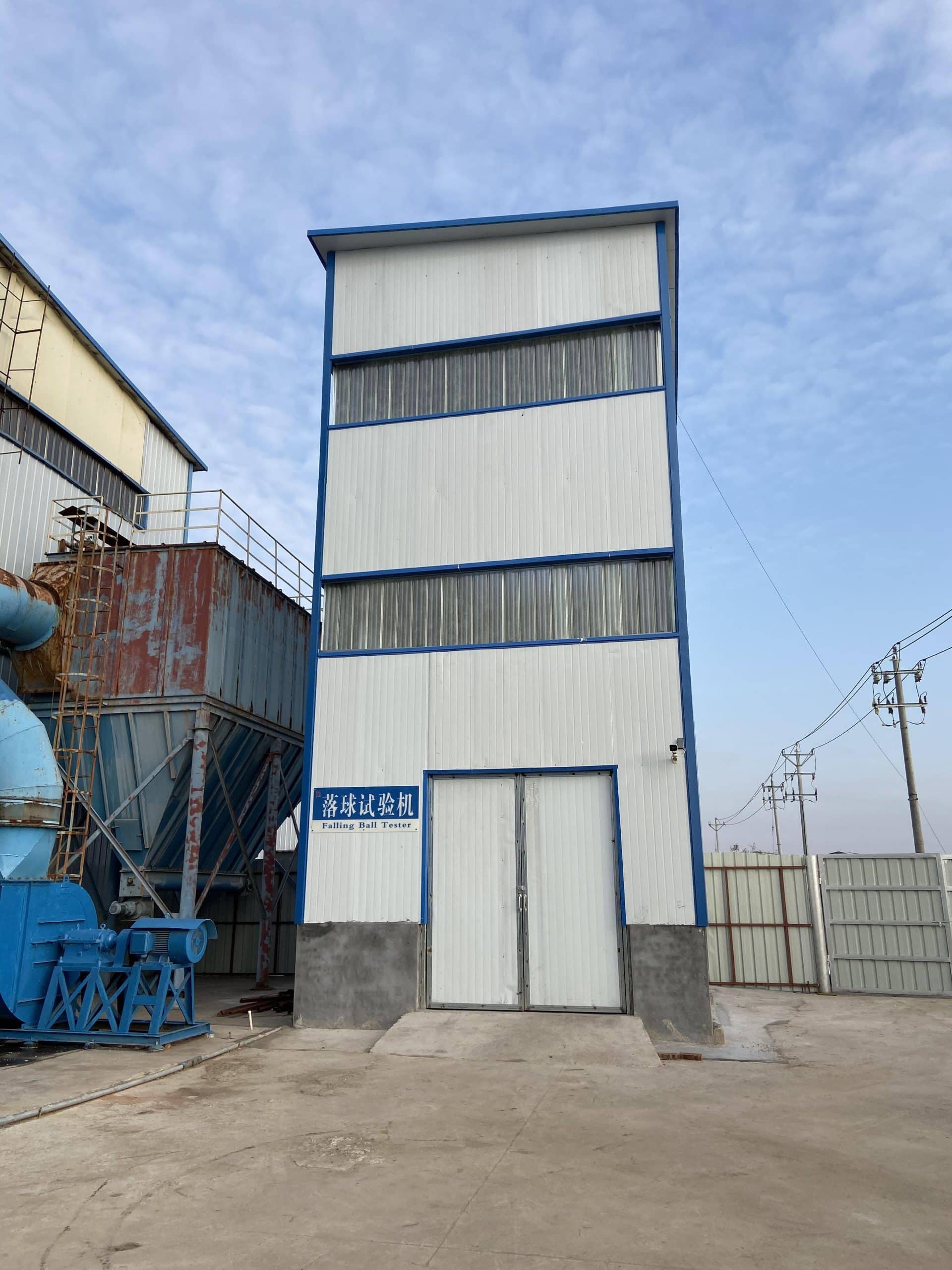
Short answer: A repeated-drop test is a useful screening method for grinding ball impact damage, but the number of drops by itself does not prove service life in a SAG mill. A meaningful report must state the ball diameter and grade, test height and contact arrangement, number of specimens, failure criteria, and results for breakage and spalling. Compare batches only under the same procedure, then confirm performance under controlled mill conditions.
By the Technical Team, Shandong Gangyan Grinding Ball Co., Ltd. | Technical Insights
Why mine buyers request a grinding ball drop test
Steel grinding media face repeated contact forces while moving with ore and other balls. In a semi-autogenous grinding (SAG) mill, the operating environment can combine large impacts with abrasion and, in wet circuits, corrosion. A poorly suited ball can fracture into large pieces, lose surface fragments through spalling, or gradually wear down. These outcomes have different effects on handling, mill charge, and cost.
The repeated-drop test subjects sample balls to repeated controlled impacts and records their resistance to damage. It is particularly useful for manufacturing quality control and comparison of production lots. It is not a full simulation of every collision in an operating mill. The useful purchasing question is therefore not simply “Did it survive 12,000 drops?” but “Under which test conditions, with what damage criteria, and how reproducibly?”
What a repeated-drop test actually measures
In one common arrangement, balls are lifted or conveyed to a fixed height and repeatedly released onto a defined impact surface or another ball. The loading history causes repeated contact stresses. Depending on the material, heat treatment, ball size and equipment geometry, the sample may develop cracks, separate into pieces, or lose smaller fragments.
Different laboratories and manufacturers use different apparatuses. A direct steel-ball-on-steel-ball setup is not interchangeable with a ball dropped onto a hardened plate. The nominal drop height alone does not define the actual energy transferred into the tested ball: contact sequence, rebound, fixture geometry and the number of simultaneously moving balls matter. Published research using discrete-element modelling shows why the energy spectra of drop-ball tests cannot be assumed identical to those in SAG mills.
Five items that must appear in a credible test report
1. Identification and traceability
Record the nominal diameter in millimetres or inches, measured diameter, steel grade, heat or lot number, manufacturing date and sampling method. A claim about “B3 grinding balls” is not sufficient without lot identification. Keep a chain between the test specimen, material test certificate (MTC), packing list and eventual shipment.
2. Apparatus and test severity
Specify the drop height, target surface, impact arrangement, cycle rate when relevant and apparatus condition. If the report states only a number of drops, another supplier cannot reproduce the test meaningfully. For comparison, use consistent equipment and operating procedures or explain any differences.
3. Sample size and selection
One surviving ball is not proof of a production lot. State how many balls were sampled, which production batches they represent, whether they were randomly selected, and whether the results refer to every sample or only the best performer. Agree the sampling plan before inspection or a third-party witness test.
4. Failure definitions
Separate catastrophic breakage (ball splitting into substantial pieces) from spalling (loss of fragments near the surface), cracks, and shallow surface marks. Specify which conditions are rejects, when testing stops, and whether damage mass is weighed. “No breakage” does not necessarily mean “no spalling.” Photographs before and after testing strengthen the report.
5. Results and acceptance rules
Record drops completed by each specimen, number and nature of failures, inspection intervals and any measured fragment losses. The acceptance threshold must be contractual or based on an agreed, disclosed method. A manufacturer-specific requirement should not be presented as a universal international standard unless the applicable published standard and clause are identified.
Breakage, spalling and abrasion are different phenomena
Breakage is fracture into relatively large sections, often with obvious operational consequences. Spalling involves pieces separating from the surface under repeated contact loading. Abrasion is more gradual material removal caused by friction and abrasive ore particles. The mechanisms may interact, but one test cannot quantify all three equally well.
Historical U.S. Bureau of Mines work compared commercial forged steel, cast steel and alloy white cast iron grinding balls using repeated-impact and laboratory abrasion experiments. It documented wide differences between products and separate impact and abrasion behaviour. The research supports testing multiple relevant properties rather than ranking every product by hardness or drops survived alone. These historic test numbers are research findings, not performance data for Gangyan products.
Why 12,000 drops cannot be compared without context
A statement such as “12,000 drops without fracture” describes an outcome under a particular test procedure. It does not disclose contact energy, sample count, size range, allowed surface damage or the probability of later failure. For example, a larger ball can experience different impact loading than a smaller one, even on the same testing machine. Repeated-drop endurance must therefore be considered alongside surface and core hardness, metallographic structure, chemical analysis and evidence of defects.
When reviewing competing offers, ask each factory to supply its full test protocol and representative records. If methods differ, arrange a side-by-side test by an agreed laboratory or witness procedure. Avoid converting the count directly into “months of mill life” or “kilograms of media per tonne of ore”: those require actual operating and wear data.
From laboratory qualification to a fair SAG mill trial
After laboratory screening, define a plant trial using the mill’s feed conditions, ore mix, operating regime and safety controls. Establish a baseline for current media before trial introduction. Record charge inventory and addition rates, identify the transition period, and document any changes in ball size, liner condition, throughput and target grind. A new ball mix can temporarily change the charge; do not call every addition during that period “consumption.”
Track the frequency and nature of broken balls, measured media consumption (kg per tonne of dry ore), circuit throughput, product size (P80) and significant operating changes. Compare quotations on the same delivered-price basis, then calculate media cost per tonne of ore only using valid plant consumption data. An excellent laboratory drop-test result is useful evidence for qualification, but the mine’s controlled trial establishes operating suitability.
Procurement checklist for forged grinding balls
- Confirm SAG or ball-mill duty, ball size, and current problems with breakage or spalling.
- Ask for steel chemistry, surface and core hardness, and batch identification.
- Request the complete drop-test procedure, not just the drop count.
- Agree minimum sample count, rejection criteria, and witness arrangements.
- Match the inspected lot to the production and shipment documents.
- Run a controlled mill trial before making a long-term consumption claim.
How Shandong Gangyan can support technical evaluation
Shandong Gangyan manufactures forged grinding balls for mineral-processing applications. For a proposed order, buyers can request product specifications and available lot-specific inspection documentation. Our technical discussion begins with mill type, ball diameter, ore conditions, current media performance and intended testing protocol. Requirements for any independently witnessed inspection must be agreed before production or dispatch.
Read our related guides on grinding ball specifications, surface and core hardness, and B2 versus B3 forged grinding balls. To discuss an inspection plan or quotation, contact our team with the required ball sizes, estimated tonnage, mill parameters, destination port and test-document requirements.
Frequently asked questions
Is 12,000 drops a universal pass standard for forged grinding balls?
No. A specific number of drops is meaningful only with the agreed apparatus, test severity, sample size and acceptance criteria. Do not describe a supplier’s internal target as an international standard without a traceable reference.
Does a high drop-test count guarantee low wear rate?
No. Repeated impacts mainly screen for resistance to certain fracture and spalling conditions; abrasive wear and corrosion require other evidence, and actual media consumption requires plant measurements.
Can results for 4-inch balls be applied to 5-inch balls?
Not automatically. Diameter changes mass and contact mechanics, and heat treatment may create different hardness profiles. Qualify the relevant size range and compare like with like.
Should a mining buyer request third-party testing?
For critical tenders or disputed performance, independent sampling or witness testing can improve confidence. Specify the laboratory, method, sampling and acceptance rules before testing.
Technical references
1. Using Discrete Element Method to Analyse the Drop Ball Test, Minerals (2024). Discussion of the impact energy spectra and limitations of laboratory drop-ball tests compared with SAG-mill collisions.
2. Evaluation of Commercial U.S. Grinding Balls by Laboratory Impact and Abrasion Tests, U.S. Bureau of Mines / NIOSH repository (1989). Historic comparison of impact and abrasion results for several commercial ball types.
Technical note: This guide explains how to evaluate tests and does not claim that any specific Gangyan production lot has passed a stated test level. Lot-specific results should be supplied and verified when requested.