
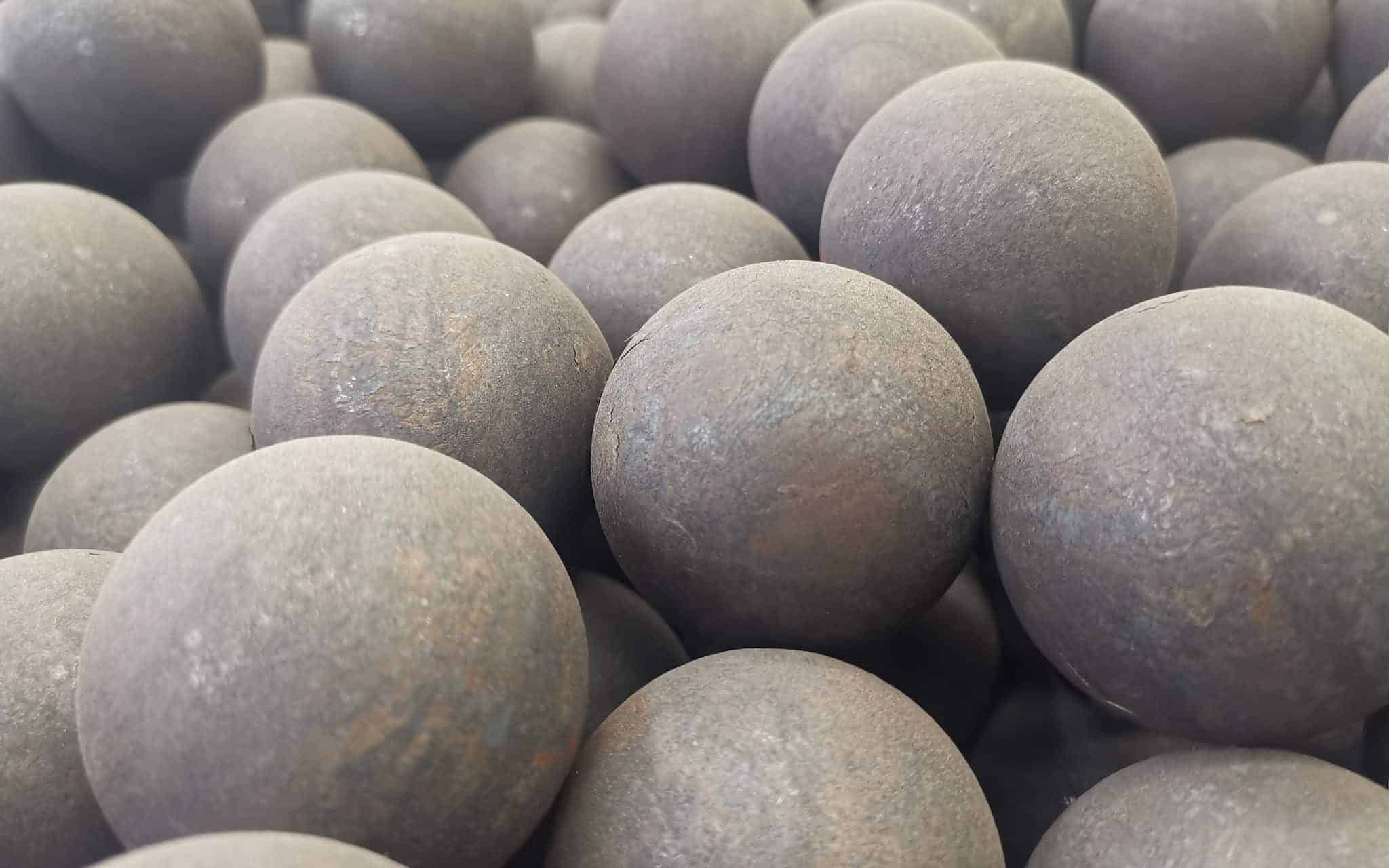
How many forged steel grinding balls are in one metric tonne? How much does a 4-inch ball weigh? These are useful questions when a mine plans a ball-mill top-up, compares supplier quotations or checks a shipment. The answers require a clear distinction between a nominal geometric estimate and the actual mass recorded on a calibrated scale.
This guide uses a conventional carbon/alloy-steel density of 7,850 kg/m³ and the volume of a sphere to calculate reference weights. It covers Gangyan’s principal forged grinding-ball diameter range of 20–150 mm. The numbers are planning tools, not certified weights or guaranteed ball counts. Material chemistry, dimensional tolerance, forging geometry and production variation must be accounted for before a contract is signed.
1. The weight formula for a forged steel grinding ball
For a nominally spherical ball, volume is πd³/6. Multiply this by material density to obtain mass. When diameter d is in millimetres and steel density is assumed to be 7,850 kg/m³, the calculation is:
Nominal mass (kg/ball) = (π ÷ 6) × (d ÷ 1,000)³ × 7,850.
Approximate balls per metric tonne = 1,000 ÷ nominal mass per ball. This is an estimate for a hypothetical tonne consisting of one diameter only. A real mixed-size delivery requires separate calculations for each size. The term “tonne” here means 1,000 kg, not a US short ton.
2. Reference table: 20–150 mm forged grinding balls
The table below is calculated from nominal diameter, perfect-sphere geometry and the stated density. It does not represent measured Gangyan batch weights. The count column is rounded to the nearest whole ball; the displayed kg figures are rounded separately.
| Diameter (mm) | Approx. kg/ball | Approx. balls/metric tonne |
|---|---|---|
| 20 | 0.033 | 30,412 |
| 40 | 0.263 | 3,801 |
| 60 | 0.888 | 1,126 |
| 80 | 2.104 | 475 |
| 100 | 4.110 | 243 |
| 120 | 7.103 | 141 |
| 125 | 8.028 | 125 |
| 150 | 13.872 | 72 |
For example, a nominal 80 mm forged steel ball has a calculated mass of approximately 2.104 kg. Dividing 1,000 kg by the unrounded value gives roughly 475 balls per metric tonne. A nominal 100 mm ball weighs about 4.110 kg, so the corresponding estimate is 243 balls per tonne. Actual delivered pieces can differ.
3. Inches are not interchangeable with rounded millimetre sizes
Mine buyers in Peru, Chile and Bolivia frequently specify 3, 4, 5 or 6 inches. The exact conversions are 3 in = 76.2 mm, 4 in = 101.6 mm, 5 in = 127.0 mm and 6 in = 152.4 mm. Therefore, an order for 4-inch balls is not automatically an order for nominal 100 mm balls. Similarly, 5-inch and 125 mm products are not geometrically identical.
Because mass scales with the cube of diameter, small dimensional differences become more important at larger sizes. If two otherwise identical balls have diameters of 100 and 101.6 mm, their nominal masses differ by approximately 4.9%. This is a geometric comparison, not a statement about acceptable manufacturing tolerances. Confirm the contractual diameter, tolerance and inspection method before using a count table.
4. Example: estimating the count in a 25-tonne shipment
Suppose a mine orders 25 metric tonnes of one nominal diameter. Ignoring packaging and using the geometric estimate, 25,000 kg divided by the unrounded mass per ball gives approximately 11,880 balls at 80 mm, 6,082 at 100 mm, or 3,114 at 125 mm. These figures are not packing-list quantities; they are useful for a plausibility check and for understanding the scale of a top-up.
For a mixed order, calculate each line independently. For example, 10 tonnes of 80 mm plus 15 tonnes of 100 mm means two separate mass-to-count estimates. Never divide the combined tonnage by an average diameter: the cubic relationship makes that shortcut incorrect. If a buyer requires an actual piece count, it should be based on agreed counting or weighing procedures rather than this table.
5. Nominal diameter, actual diameter and forging geometry
A forged ball is a manufactured component, not an ideal mathematical sphere. Dimensional tolerance, slight flats at the forming poles, roundness and surface condition may change the actual mass. Different alloy compositions also have slightly different densities. A catalogue calculation cannot establish whether a particular shipment meets a diameter tolerance or a mass requirement.
Shandong Gangyan’s inspection scope includes diameter and roundness measurement, chemical composition, surface and core hardness, metallography and applicable impact or drop tests. For procurement, ask for the agreed sampling plan and the inspection results relevant to the specific batch. Where a weight-per-piece tolerance is critical, specify that requirement separately and verify it by measurement.
6. Net steel mass is not gross container mass
A commercial invoice may show net grinding-media mass, while a container document also reflects packaging, pallets, liners, dunnage and other tare. The container’s maximum permitted payload and the road/port limits are separate constraints. A nominal 25-tonne grinding-ball order does not mean the packed container weighs exactly 25 tonnes.
When planning an international shipment, confirm the net product weight, packaging weight, verified gross mass, container payload, loading method and destination-port handling requirements. If the cargo will be stripped at a transit port and carried onward by truck, the inland axle-load limits matter as well. Piece-count calculations are not a substitute for verified gross mass or carrier instructions.
7. Does the number of balls determine the best grinding performance?
No. A tonne of small balls contains more individual pieces and presents more total geometric surface area than a tonne of large balls, but the best charge depends on ore feed size, ore competence, mill diameter, mill speed, liner configuration, charge level and the target grind. Larger balls deliver different impact conditions from smaller balls. Neither “more balls” nor “heavier balls” is a universal optimization rule.
For ball mills, the top-up distribution must be assessed against the operating charge and grinding duty. For SAG mills, impact severity and breakage resistance may place additional constraints on the diameter and material grade. Gangyan’s B2 and B3 forged grinding balls are selected according to the application; the grade label alone does not guarantee a particular wear rate or plant result.
8. Why weight calculations cannot replace quality inspection
Two balls of equal nominal mass may have different chemistry, hardness distribution, microstructure and impact resistance. Likewise, two batches with similar total net weight may have different size distributions or dimensional conformity. Weight is a logistics and inventory parameter; it is not a direct measure of grinding-media quality.
A meaningful purchasing specification should separately define the alloy grade, nominal diameter and tolerance, surface/core hardness requirements, impact or repeated-drop criteria where applicable, acceptable surface condition, batch identification, sampling and documentation. Independent inspection can be arranged when required. Field wear and consumption must be assessed under the mine’s actual operating conditions.
9. A practical checklist for mine procurement teams
Before requesting a quotation, record the exact nominal diameter and unit (mm or inch), grade, quantity in net metric tonnes, required delivery port, packaging, applicable dimensional tolerance and any required inspection standard. Ask whether the quotation is based on net steel weight or another commercial basis. For replenishment planning, add current consumption in kg/t of ore, operating hours, mill type, existing charge sizes and forecast throughput.
At shipment, reconcile the purchase order, packing list, net weight, gross weight and batch-linked inspection records. A ball-count estimate is a useful secondary reasonableness check, but the accepted quantity should follow the contract’s weighing and verification terms. Document any discrepancy before final acceptance.
10. About Shandong Gangyan
Shandong Gangyan Grinding Ball Co., Ltd., based in Tai’an, Shandong, China, is a grinding-media manufacturer whose manufacturing history dates to 1988. Its core forged grinding-ball offering includes B2 and B3 alloy-steel grades in diameters of approximately 20–150 mm for ball mills and SAG mills. Production and quality records can cover chemistry, surface and core hardness, dimensions, roundness, microstructure and impact-related testing according to the agreed order.
For the product range, see our forged steel grinding balls. To request a grade/diameter review and a commercial offer, contact Gangyan with mill information, ore characteristics, current ball size, required quantity and destination port. The factory can confirm which dimensions, test records and packaging arrangements apply to the proposed shipment.
Frequently asked questions
How many 80 mm forged steel grinding balls are in one tonne?
Approximately 475 under the ideal-sphere assumption at 7,850 kg/m³. This is not a guaranteed production count.
What is the calculated weight of a 100 mm grinding ball?
Approximately 4.110 kg per ball. Actual mass depends on measured diameter, geometry and alloy density.
Is a 4-inch ball the same as a 100 mm ball?
No. Four inches is exactly 101.6 mm. The diameter and tolerance in the purchase order control.
Can the table be used to determine container gross weight?
No. It estimates net steel mass only; packaging, container tare and other loading components must be accounted for separately.
Can ball weight predict wear rate or breakage?
No. Wear and fracture also depend on metallurgy, hardness/toughness balance and the actual mill and ore environment.
Calculation basis and technical references
Geometric calculations use sphere volume and the conventional 7,850 kg/m³ steel-density assumption. For the effect of hardenability and heat treatment on large forged balls, see Hardenability of large diameter forged steel grinding balls. For the distinction between laboratory impact/abrasion testing and plant performance, see Evaluation of commercial US grinding balls by laboratory impact and abrasion tests. These are independent technical sources, not claims of Gangyan’s measured field results.