



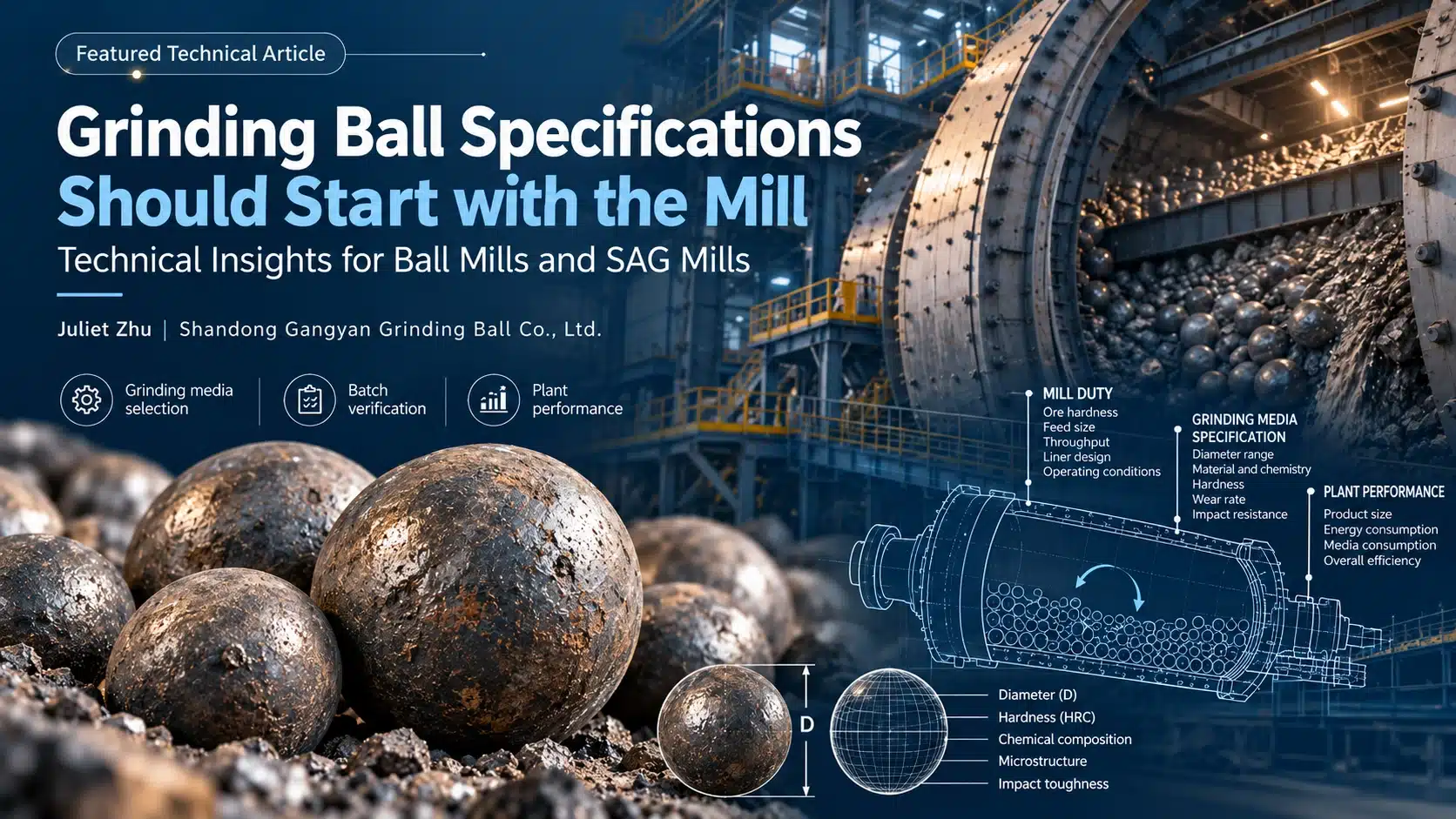
Grinding ball specifications should connect mill duty to measurable acceptance criteria: diameter and tolerance, steel chemistry, surface and core hardness, impact resistance, and batch traceability. For SAG and ball mills, selection also requires ore, feed, charge and slurry data. Laboratory results support qualification; controlled plant trials establish grinding media consumption, breakage behaviour and cost per tonne of ore under the mine’s actual operating conditions.
Featured image: a composite technical illustration of grinding balls and mill selection; the mill scene is illustrative.
Juliet Zhu’s technical perspective in Global Mining Review
On 12 October 2026, Global Mining Review published Grinding ball specifications should start with the mill. Its introductory attribution identifies Juliet Zhu and her role at Shandong Gangyan Grinding Ball Co., Ltd. The webpage separately lists Jody Dodgson, Editorial Assistant, under its editorial byline.
The contribution connects application requirements, delivery inspection and plant evaluation. This original companion guide develops that discussion into practical purchasing decisions. The publication is technical commentary, not product certification or a third-party assessment of Gangyan’s grinding balls.
Why grinding ball specifications begin with mill duty
A steel ball works within a changing charge of ore, media and, in wet grinding, slurry. Its performance depends on how that system transfers energy and exposes steel to abrasion, impact and corrosion.
Record mill diameter, speed as a percentage of critical speed, liner condition, ball filling and total charge filling. Distinguish ore competence, meaning resistance to breakage, from abrasiveness, meaning its tendency to wear steel. Include feed F80 and product P80: the sizes through which 80% of the respective material passes.
For wet circuits, also document slurry solids, pH and water chemistry. Matching an ore name alone cannot establish a suitable alloy or media size. A copper or gold circuit can change substantially as the ore blend changes.
SAG mill grinding balls versus ball mill grinding balls
SAG mills combine ore and steel media in primary grinding. Ball mills commonly treat finer feed downstream. These duties often create different impact and wear environments, although actual conditions depend on mill design and operation.
| Duty | Main assessment | Selection question |
|---|---|---|
| SAG mill | Resistance to fracture under large impacts, alongside abrasive wear | Does the proposed ball withstand the charge motion and feed conditions? |
| Ball mill | Size distribution and wear resistance, with adequate impact resistance | Does the charge maintain the required throughput and product size? |
Neither mill type justifies a universal hardness target. Start with the mill manufacturer’s operating limits and the site’s metallurgical assessment, then define the media requirements.
Connect diameter, chemistry, hardness and toughness
Diameter and chemical composition
For equal-density spheres, individual ball mass increases with diameter cubed. At the same total media mass, smaller balls offer more total surface area. These geometric relationships explain the trade-off between individual impacts and grinding contact; they do not determine an optimum charge independently of feed size and mill conditions.
Carbon content, alloying elements and heat treatment influence hardenability and microstructure. Hardening a large ball through its section presents a different cooling challenge from hardening a small ball. Grade labels such as B2 and B3 therefore need agreed chemical limits and size-specific inspection requirements.
Surface hardness, core hardness and toughness
Grinding ball hardness is commonly expressed as Rockwell C hardness, or HRC. Specify test locations and specimen preparation. A core reading requires a prepared section; it cannot be inferred from a surface reading.
Hardness measures resistance to indentation. Toughness concerns resistance to fracture and must be assessed separately. Read the hardness profile alongside impact results, microstructure and defect inspection. Gangyan’s surface and core hardness guide explains these distinctions further.
Grinding ball quality testing and the MTC
A material test certificate, often called an MTC or mill test certificate, should connect delivered material to identifiable production and test records. A generic specification sheet describes a product offering; it does not show what was measured on the shipment.
Before ordering, agree a lot definition, representative sampling plan, acceptance limits and a procedure for nonconforming material. Request:
- Heat and production-lot identifiers linked to the packing list.
- Chemical analysis and the applicable material specification.
- Diameter, tolerance, roundness criteria and visual inspection results.
- Surface and cross-sectional hardness results with test positions.
- Agreed impact or repeated-drop results, including apparatus, specimen details and acceptance criteria.
Drop counts and impact values are comparable only when the methods and test conditions are comparable. A manufacturer’s MTC is also distinct from independent inspection; arrange third-party witnessing separately when the purchase requires it. Gangyan’s forged grinding ball manufacturing guide provides production context.
Separate grinding media wear rate from breakage
Abrasion gradually removes material; spalling detaches fragments; fracture splits a ball. Corrosion can contribute in wet grinding. Keep these observations separate when investigating lost media and changes in charge size distribution.
For a plant trial, identify the baseline, batches, replacement schedule and sampling method in advance. Track operating hours, media additions, dry tonnes treated, power, throughput, P80 and recovered fragments. Record ore changes, liner work and adjustments to mill operation.
Account for the transition from the existing charge: the new product initially operates in a mixed population. There is no fixed trial duration suitable for every circuit. Allow enough turnover and representative operation to evaluate the agreed questions.
Marked-ball tests can compare recovered specimens under shared conditions, but recovery bias, marking damage and mixed-media interactions require attention. Laboratory abrasion tests can screen candidates; they should not be presented as a guaranteed site wear rate. The research by Jankovic, Wills and Dikmen listed below discusses comparative testing and its limitations.
Compare purchase price with cost per tonne of ore
Use the same delivery basis when comparing quotations, and distinguish media cost from total grinding-circuit cost.
Media cost per tonne of ore = delivered media price (USD/t of media) × media consumption (kg/t of dry ore) ÷ 1000.
Illustrative arithmetic only: media priced at USD 800/t and consumed at 0.80 kg/t costs USD 0.64 per tonne of ore. At USD 900/t and 0.65 kg/t, the media cost is USD 0.585 per tonne of ore. These are hypothetical inputs, not Gangyan quotations or trial results.
For a stable charge, additions divided by dry tonnes treated can approximate grinding media consumption. If charge inventory changes, use a mass balance: opening inventory plus additions, less closing inventory and measured intact withdrawals. State how fragments and other losses are classified. An increased charge must not be counted automatically as consumed steel.
Then assess energy in kWh/t, throughput, required P80, handling, interruptions and downstream metallurgical performance where relevant. Lower media expenditure is useful only if the circuit still meets its production requirements.
A practical checklist for buyers and process engineers
- Define the mill duty, ore variability, feed distribution and target product.
- Record charge conditions, liner condition, speed and wet-grinding chemistry.
- Specify nominal diameters, tolerances and the proposed addition mix.
- Agree chemical limits, hardness positions and impact-test methods.
- Define lot traceability, sampling, acceptance and dispute procedures.
- Set the trial baseline, charge-transition plan and evaluation measures.
- Compare delivered cost, consumption and circuit performance together.
Keep units explicit in international tenders. For example, 4 inches equals 101.6 mm; a nominal 100 mm product needs its own agreed tolerance rather than an assumed equivalence.
Technical and purchasing support from Shandong Gangyan
Shandong Gangyan supplies forged grinding balls for mineral-processing applications. Buyers evaluating a forged steel grinding ball manufacturer can request a proposal covering diameter, grade, chemical limits, hardness requirements, inspection records, packaging and shipment terms.
Ask our team to confirm the MTC and testing documentation available for the proposed order. Manufacturer-provided specifications describe the offered material and acceptance requirements; consumption, service life and cost outcomes require site validation.
To request a technical review and quotation, contact Juliet Zhu and the Gangyan team with mill type, ball diameters, quantity, ore and operating data, current media issues, required documents and destination port. Include the Incoterm and any inland-delivery requirements so the quotation has a clear commercial basis.
Frequently asked questions
What should a grinding ball specification include?
Include diameter and tolerance, chemistry, hardness profile, impact-test requirements, sampling, acceptance criteria and batch traceability. Attach the mill-duty information used to select those requirements.
Are the hardest forged grinding balls always the best choice?
No. An HRC value does not establish resistance to fracture or performance in a particular slurry. Evaluate hardness with toughness, material integrity and representative operating results.
Can the same media be used in SAG and ball mills?
Possibly, if the dimensions, metallurgy and test evidence suit both duties. Approval for one circuit should not be transferred automatically to another.
Is grinding media wear rate the same as consumption?
No. Wear rate describes material loss under a defined method, such as mass loss per exposed area and time. Plant consumption in kg/t can include wear, breakage and other losses, depending on the accounting boundary.
Does an MTC guarantee low consumption at my mine?
No. It records specified material tests and traceability. Consumption also depends on the ore and operating environment, so a controlled plant evaluation remains necessary.
Sources and technical basis
Media publication: Global Mining Review, 12 October 2026, linked above. Technical reference: A. Jankovic, T. Wills and S. Dikmen, A comparison of wear rates of ball mill grinding media, Journal of Mining and Metallurgy, 52 A (1), 2016, pp. 1–10. The purchasing checklist and hypothetical cost calculation are this article’s practical guidance; they are not reported mine results.