
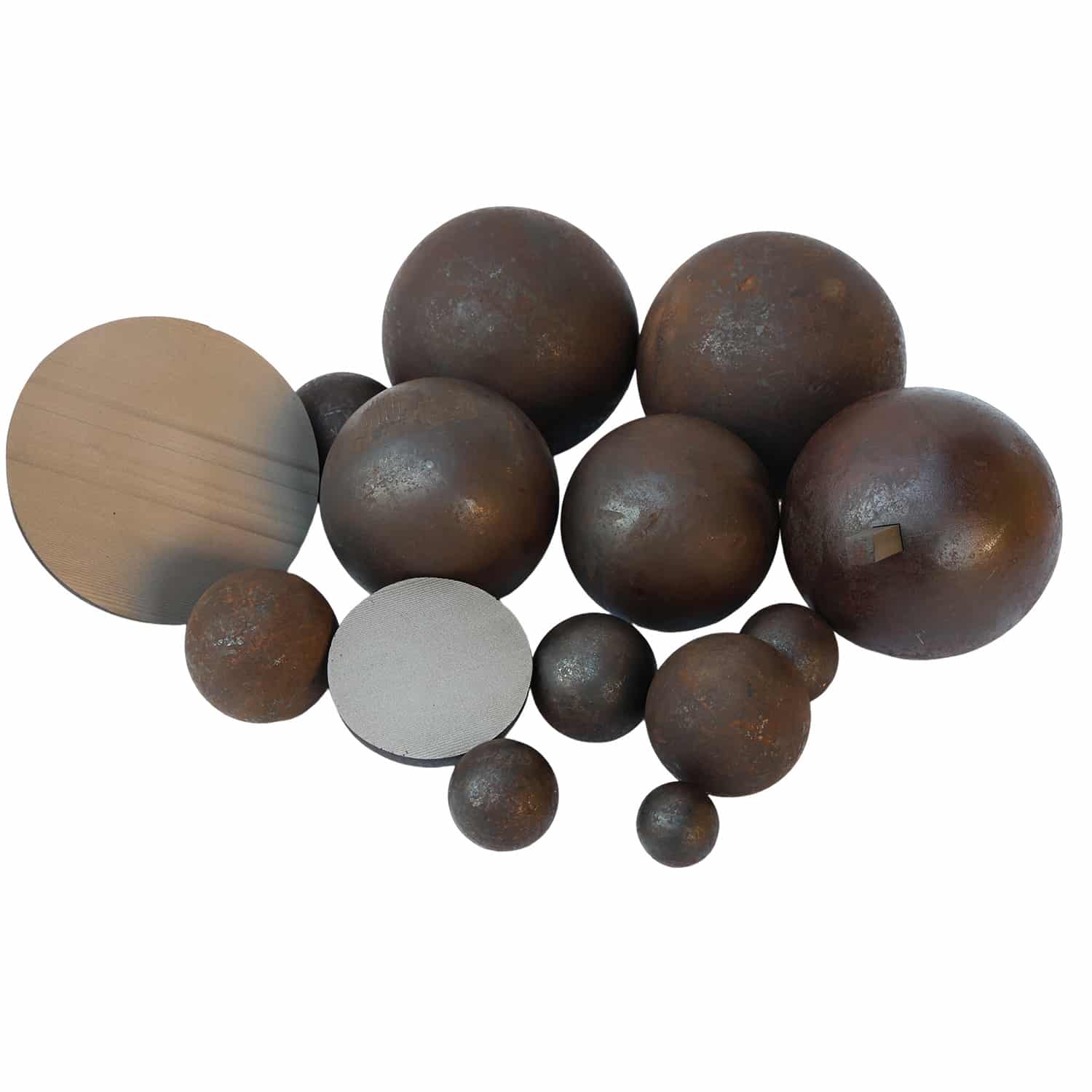
Why a make-up ball policy matters
In a continuously operating ball mill, grinding balls lose diameter through abrasion and other wear mechanisms. The plant replaces this lost steel with new make-up balls (also called top-up balls). Choosing their diameter and addition schedule is an operating decision, not simply a purchase of the cheapest available tonne of steel. A change in make-up size affects the population of contacts in the mill, the ability to break the coarsest particles, the amount of fine grinding, the circulating load and ultimately the media inventory that procurement must secure.
This guide focuses on secondary ball mills in mineral processing. A SAG mill has a different mixture of ore, rocks and steel, different impact conditions and often a different make-up-ball policy. Do not transfer a ball-mill recipe directly to a SAG circuit. Shandong Gangyan Grinding Ball Co., Ltd. supplies forged grinding balls; the operating plant and its process engineers should approve any charging change.
Make-up size is not the same as the in-mill size distribution
The make-up ball diameter is the nominal size delivered to the charging point. The in-mill ball size distribution includes both recently added balls and smaller balls that have worn during service. It changes with operating hours, ore feed, discharge conditions, breakage, purge practices and the mix of sizes added. A purchase order for 80 mm balls does not mean the entire charge consists of 80 mm balls.
Bond’s classic work on grinding-ball size selection explains why oversized make-up balls may reduce the number of useful contacts, while undersized balls may not break the largest feed particles. His work is a framework, not a universal diameter table. A subsequent simulation study by Cho and coauthors found that the preferred make-up composition depends on feed size, product size, mill diameter and ore breakage parameters. This is why a supplier should ask about the circuit before recommending a size.
The operating data to collect before selecting diameters
Start with a short, auditable plant data sheet. Record the mill internal diameter and effective length, liner and lifter configuration, installed and operating power, speed, charge filling estimate and the current steel-ball inventory. For a closed-circuit mill, add cyclone feed and overflow conditions, circulating-load estimates and the target product size, usually expressed as P80. The ore feed F80 and the upper tail of the feed-size distribution matter: a single average feed size hides coarse particles that need high-energy impacts.
Document ore type and variability, quartz or other abrasive mineral content, moisture and slurry conditions where relevant. Include current make-up sizes, charging frequency, steel tonnage per addition, monthly ore throughput, observed ball breakage, spalling and media consumption in kg/t. Record the method used to measure each number and any missing information. Do not confuse a supplier’s nominal hardness with the actual mill’s grinding performance.
Single-size versus mixed-size top-up
A single nominal make-up size can simplify purchasing, unloading and dosing, but it is not automatically the optimum for every ore and mill. A mixture may supply both large impacts for coarser particles and more contacts for finer material. The appropriate ratio must be demonstrated for the specific circuit. In a published Sarcheshmeh copper-mine study, Banisi and Farzaneh compared an 80 mm make-up regime with a mixture of 80 and 60 mm forged balls in a particular grinding and flotation circuit. They reported improved fine generation under their test conditions; the result is not a guaranteed improvement for other mines.
For an initial discussion, ask the plant whether it is evaluating a single size, a controlled two-size mix or a broader distribution. Do not prescribe a universal 75/25 or 50/50 mass ratio from a case study. Verify the required top size first, then test the proposed blend against the current baseline with the same ore and operating constraints.
Ball diameter, inch labels and contractual tolerances
Use the actual nominal diameter on the purchase order, not an ambiguous inch nickname. Four inches equals 101.6 mm, while 100 mm is 3.937 inches; they are not mathematically identical. Three inches equals 76.2 mm and five inches equals 127.0 mm. In Latin American procurement, customers frequently describe balls in pulgadas; the commercial specification should still state the agreed nominal diameter in mm or inches, applicable dimensional tolerance and inspection method.
Diameter and roundness tolerances affect both acceptance and the actual delivered size population. Agree on sampling and measuring instruments, the number of balls per lot, the treatment of borderline results and the disposition of nonconforming batches. A warehouse label alone cannot establish compliance. Ask for a packing list that distinguishes each diameter, grade, net mass and traceable production lot.
How to estimate the replacement tonnage
For a first planning estimate, multiply the measured media consumption by the planned ore throughput: make-up steel (t) = consumption (kg/t ore) × ore throughput (t ore) ÷ 1,000. For example, if a mine processes 90,000 t of ore in a month and its measured consumption is 0.65 kg/t, the implied monthly replacement is 58.5 t. This is a hypothetical arithmetic example, not a Gangyan field result or a recommended consumption benchmark.
Actual deliveries also need a stock adjustment: opening inventory + receipts − issues = closing inventory, allowing for stock-count differences and the plant’s minimum safety stock. If two sizes are charged, split the planned tonnage by the approved mass fraction and keep separate issue records. Review procurement lead time, transport disruptions and available unloading capacity before selecting the reorder point. A ball consumption estimate does not by itself define the mill’s total initial ball charge.
Daily, weekly or campaign-based additions?
The charging interval should follow plant operating practice, safe access and the ability to maintain a reasonably stable mill load. Some plants add balls routinely; others batch additions around shifts, maintenance windows or campaigns. The goal is controlled inventory and consistent operating conditions, not a universal instruction to add balls every day. A sudden large addition may alter charge motion or draw power, so the operating team must review the equipment’s charging procedure and safeguards.
For each addition, log date, shift, mill, ball size, grade, lot number, net tonnes charged and the operator’s confirmation. Pair that log with ore throughput, mill power, feed and product particle sizes, and abnormal observations. The purchasing team can then compare consumption and replenishment needs without confusing deliveries to site with actual balls added to the mill.
Design a plant trial without creating false savings claims
Before changing the make-up policy, agree on a baseline period, a trial period, stable comparison conditions and the primary success metric. Depending on the circuit, this may be tonnes processed at a target P80, energy per tonne, classification performance, media consumption in kg/t, ball breakage or the combined operating cost. Monitor ore hardness and blend changes, liner condition, mill filling, cyclone settings and downstream recovery, because these variables can overwhelm the effect of a ball-size change.
Use representative sampling, a documented mass balance and a trial long enough to observe the charge’s gradual evolution. A short trial may still contain a large inventory of older balls. Define a decision rule before seeing the results and retain the raw data, including any adverse outcomes. Laboratory abrasion or drop tests provide useful quality evidence, but they do not establish site-specific throughput gains, reduced electricity consumption or longer ball life.
Specify forged-ball quality alongside the top-up policy
A make-up-size trial is meaningful only when ball quality is controlled. For a quotation, request steel grade, agreed chemistry, surface and core hardness with test positions, microstructure or metallography where specified, impact or repeated-drop testing method, diameter and roundness records, and lot traceability. Ask the manufacturer to distinguish its routine production controls from independent third-party witnessing, which requires a separate agreement.
Shandong Gangyan produces forged grinding balls in the B2 and B3 series for different milling duties. As a general application discussion, B2 may be considered for conventional ball-mill diameters and B3 for demanding large-ball or high-impact duties; final selection must reflect the mill and verified lot data. The company can provide production and inspection documentation applicable to the proposed batch. No laboratory result should be represented as a measured benefit at the buyer’s mine.
A purchasing checklist for multi-size deliveries
Prepare a purchase specification that states the approved make-up diameters, grade, mass split, total tonnage, packaging, delivery port and delivery terms. Require separate identification of each size and lot on invoices, packing lists and material test records. If the site has an automated ball charger, verify compatibility with the charger opening, conveyors, lifting gear and feeding system before ordering. Ask for shipping and unloading constraints early; an efficient laboratory blend is not useful if the site cannot reliably segregate and charge it.
Build a rolling forecast using measured consumption and the next shipment’s realistic lead time. Confirm who signs off a trial change, who records balls actually charged, who analyses operating results and who can approve a revised purchase specification. Clear responsibility prevents a supplier recommendation from becoming an unreviewed plant operating change.
Frequently asked questions
Is the largest ball always the best make-up size?
No. The top size must break the coarsest relevant feed, but excessively large balls can reduce the number of effective contacts. Evaluate the circuit and trial results.
Can a plant add 60 mm and 80 mm balls together?
Potentially, yes, if its engineering team has approved the mix. A published case study is not a transferable recipe; validate mass fractions, charging equipment and product-size effects.
Is 4 inches exactly 100 mm?
No. Four inches is 101.6 mm. Put the intended nominal diameter and acceptance tolerance in the contract.
How is monthly top-up tonnage estimated?
Multiply measured kg of media consumed per tonne of ore by planned ore tonnes, then divide by 1,000. Adjust orders for stock and lead time.
Do hardness and drop tests prove lower consumption?
No. They support manufacturing quality evaluation; a controlled plant trial is required to establish actual wear, breakage and economic performance.
Technical enquiry and references
For a plant-specific forged grinding ball top-up quotation, send Shandong Gangyan the mill dimensions and type, ore F80 and target P80, current ball sizes, measured kg/t, expected monthly tonnage, preferred B2/B3 grade if specified, and the destination port. We can discuss manufacturing specifications and supply planning while your process team evaluates the charging regime. See our grinding ball specification guide, media consumption trial guide, and contact page.
Sources and further reading: F. C. Bond, Grinding Ball Size Selection (1958); S. Banisi and M. Farzaneh, Effect of ball size on the performance of grinding and flotation circuits (2006); H. Cho et al., Optimum choice of the make-up ball sizes for maximum throughput in tumbling ball mills (2013); A Review of the Grinding Media in Ball Mills for Mineral Processing (2023). These are research references, not Gangyan performance certificates.